-

- Sopto Home
-

- Special Topic
-
- Converter Knowledge
-
- What is Alternating Current and Direct Current?

Converter Knowledge
- Form Factors and Application of Ethernet Media Converter
- Ethernet over 4 E1 Converter Brief Introduction
- What is the Difference between RS232 and RS485 Serial Interfaces
- What is the Difference between RS232 and RS485 Serial Interfaces
- How to Convert an Analog Telephone to VoIP Protocol?
- How to Find the Internet Protocol Address and Media Access Contr
- How to Convert from Fast Ethernet to Fiber Optics?
- How to Connect a Fiber Converter?
- How to Convert Ethernet to Fiber Media Converters?
SOPTO Special Topic
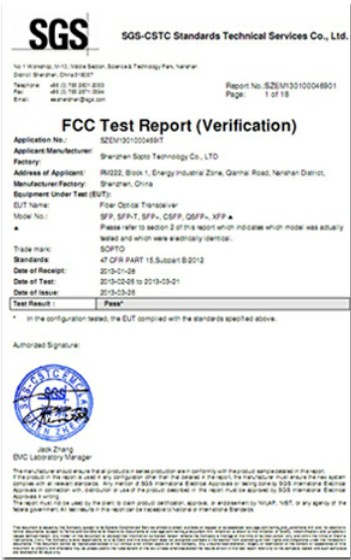
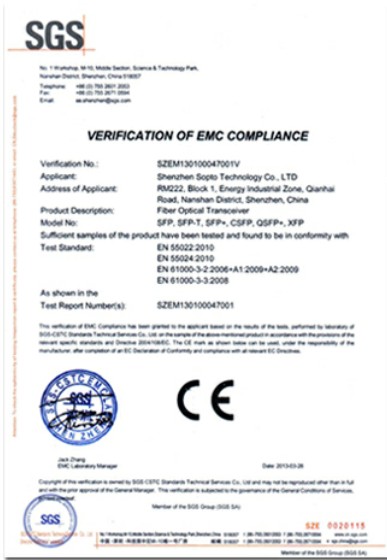
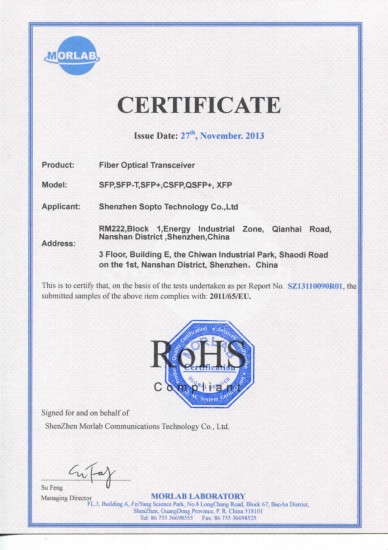
Certificate
Guarantee
Except products belongs to Bargain Shop section, all products are warranted by SOPTO only to purchasers for resale or for use in business or original equipment manufacturer, against defects in workmanship or materials under normal use (consumables, normal tear and wear excluded) for one year after date of purchase from SOPTO, unless otherwise stated...
Return Policies
Defective products will be accepted for exchange, at our discretion, within 14 days from receipt. Buyer might be requested to return the defective products to SOPTO for verification or authorized service location, as SOPTO designated, shipping costs prepaid. .....
Applications
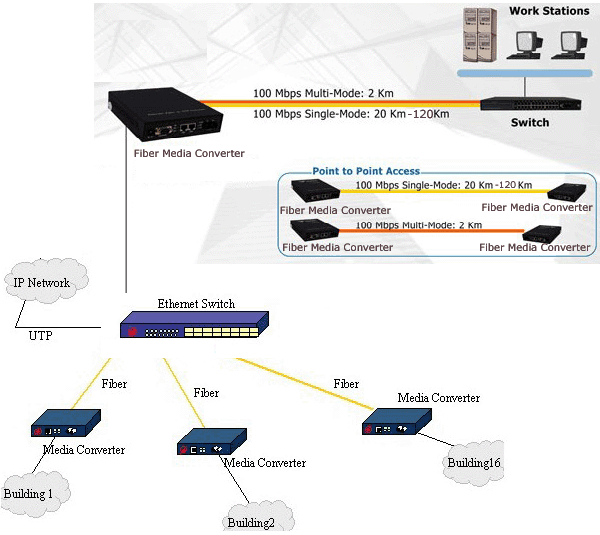
An Ethernet to Fiber Media Converter can also be used where there is high level of electromagnetic interference or EMI which is a common phenomenon found in industrial plants. This interference can cause corruption of data over copper-based ethernet links. Data transmitted over fiber optic cable however is completely immune to this type of noise. An Ethernet to Fiber Optic Converter therefore enables you to inter-connect your copper-ethernet devices over fiber ensuring optimal data transmission across the plant floor.
SNS Page


SOPTO Products
- Fiber Optic Transceiver Module
- High Speed Cable
- Fiber Optical Cable
- Fiber Optical Patch Cords
- Splitter CWDM DWDM
- PON Solution
- FTTH Box ODF Closure
- PCI-E Network Card
- Network Cables
- Fiber Optical Adapter
- Fiber Optical Attenuator
- Fiber Media Converter
- PDH Multiplexers
- Protocol Converter
- Digital Video Multiplexer
- Fiber Optical Tools
- Compatible
Related Products
Performance Feature
Converter Knowledge
Recommended
What is Alternating Current and Direct Current?
Electricity flows in two ways: either in an alternating current (AC) or in a direct current (DC). Electricity or 'current' is nothing more than moving electrons along a conductor, like a wire, that have been harnessed for energy. Therefore, the difference between AC and DC has to do with the direction in which the electrons flow. In DC, the electrons flow steadily in a single direction, or "forward." In AC, electrons keep switching directions, sometimes going "forward" and then going "backward."
In electricity, alternating current (AC) occurs when charge carriers in a conductor or semiconductor periodically reverse their direction of movement. Household utility current in most countries is AC with a frequency of 60 hertz (60 complete cycles per second), although in some countries it is 50 Hz. The radio-frequency (RF) current in antennas and transmission lines is another example of AC.

DC (direct current) is the unidirectional flow or movement of electric charge carriers (which are usually electrons). The intensity of the current can vary with time, but the general direction of movement stays the same at all times. As an adjective, the term DC is used in reference to voltage whose polarity never reverses.
In a DC circuit, electrons emerge from the negative, or minus, pole and move towards the positive, or plus, pole. Nevertheless, physicists define DC as traveling from plus to minus.
Direct current is produced by electrochemical and photovoltaic cells and batteries. In contrast, the electricity available from utility mains in most countries is AC (alternating current). Utility AC can be converted to DC by means of a power supply consisting of a transformer, a rectifier (which prevents the flow of current from reversing), and a filter (which eliminates current pulsations in the output of the rectifier).
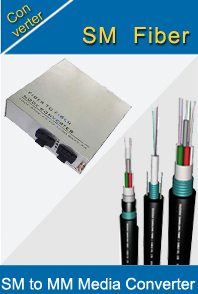
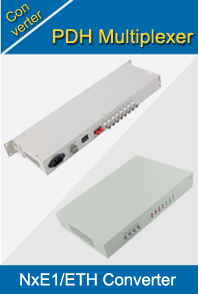
Sopto supplies high quality fiber media converters, like SM to MM Media Converters, PD Media Converters and PSE Media Converters, which all support AC or DC. For more info, please browse our website. For purchasing more fiber media converters, please contact a Sopto representative by calling 86-755-36946668, or by sending an email to info@sopto.com.