-

- Sopto Home
-

- Special Topic
-
- Converter Knowledge
-
- Standards Hurdles of Fiber Media Converters

Converter Knowledge
- Form Factors and Application of Ethernet Media Converter
- Ethernet over 4 E1 Converter Brief Introduction
- What is the Difference between RS232 and RS485 Serial Interfaces
- What is the Difference between RS232 and RS485 Serial Interfaces
- How to Convert an Analog Telephone to VoIP Protocol?
- How to Find the Internet Protocol Address and Media Access Contr
- How to Convert from Fast Ethernet to Fiber Optics?
- How to Connect a Fiber Converter?
- How to Convert Ethernet to Fiber Media Converters?
SOPTO Special Topic
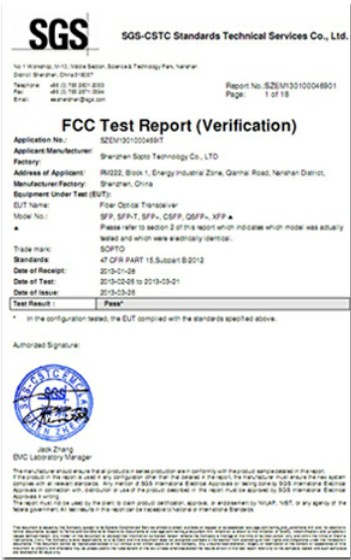
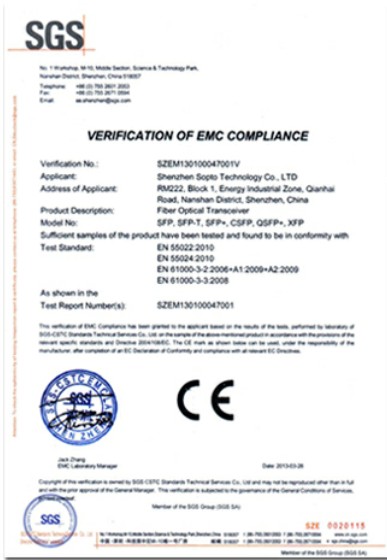
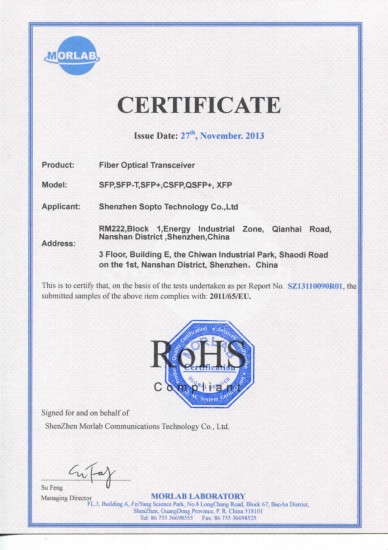
Certificate
Guarantee
Except products belongs to Bargain Shop section, all products are warranted by SOPTO only to purchasers for resale or for use in business or original equipment manufacturer, against defects in workmanship or materials under normal use (consumables, normal tear and wear excluded) for one year after date of purchase from SOPTO, unless otherwise stated...
Return Policies
Defective products will be accepted for exchange, at our discretion, within 14 days from receipt. Buyer might be requested to return the defective products to SOPTO for verification or authorized service location, as SOPTO designated, shipping costs prepaid. .....
Applications
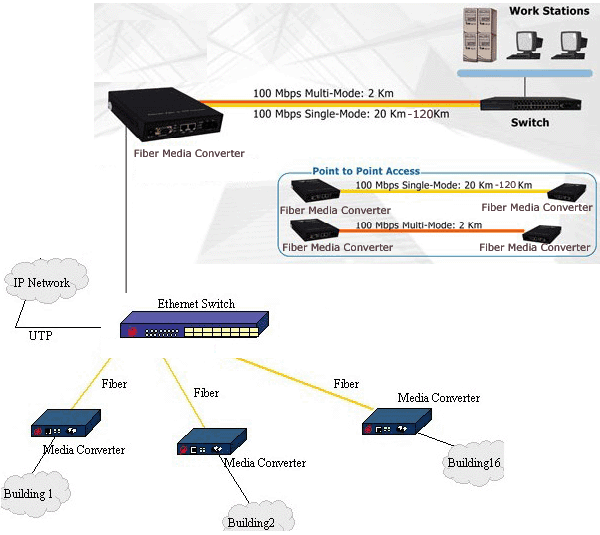
An Ethernet to Fiber Media Converter can also be used where there is high level of electromagnetic interference or EMI which is a common phenomenon found in industrial plants. This interference can cause corruption of data over copper-based ethernet links. Data transmitted over fiber optic cable however is completely immune to this type of noise. An Ethernet to Fiber Optic Converter therefore enables you to inter-connect your copper-ethernet devices over fiber ensuring optimal data transmission across the plant floor.
SNS Page


SOPTO Products
- Fiber Optic Transceiver Module
- High Speed Cable
- Fiber Optical Cable
- Fiber Optical Patch Cords
- Splitter CWDM DWDM
- PON Solution
- FTTH Box ODF Closure
- PCI-E Network Card
- Network Cables
- Fiber Optical Adapter
- Fiber Optical Attenuator
- Fiber Media Converter
- PDH Multiplexers
- Protocol Converter
- Digital Video Multiplexer
- Fiber Optical Tools
- Compatible
Related Products
Performance Feature
Converter Knowledge
Recommended
Standards Hurdles of Fiber Media Converters
The 802.3 body of the Institute of Electrical and Electronics Engineers established early standards for 10- and 100-Mbit/sec Ethernet applications, including the 10Base-FL and 100Base-FX (fiber) and 10Base-T and 100Base-TX (copper) specifications. The media, distance, and connector interfaces defined within the 10Base-T and 100Base-TX copper-based standards are the same. More importantly, from an IEEE perspective, a defined standard-ANSI/TIA/EIA-568B.3-is in place for unshielded twisted-pair (UTP) cabling. And Category 5 cable can be used for 10Base-T or 100Base-TX.

Additionally, most installers and users are more familiar with UTP than with fiber. And most Ethernet ports-such as network interface cards (NICs) and PC motherboards-support both 10Base-T and 100Base-TX. All these factors make UTP an easy and popular choice among cabling system installers and users. In contrast, standard specifications governing optical-based transmission traditionally have put obstacles in the paths of users considering deploying fiber in the horizontal.
One fact that has significantly slowed deployment of horizontal fiber is that the 10 and 100 Mbit/sec optical Ethernet standards specify different source wavelengths and coupler interfaces. The 10Base-FL standard specifies an 850-nanometer (nm; short-wavelength) LED source and ST connector interface; the 100Base-FX standard specifies a 1300-nm (long-wavelength) LED source and duplex SC connector interface. That means users upgrading from 10Base-FL to 100Base-SX must physically change the optical source and receiver, as well as the NICs at the workstations and within hubs and switches (because of the dissimilar ST and SC interfaces).
Why did the IEEE do this? The answer is in the performance of fiber cable. When the IEEE standards were set, 62.5/125-µm multimode fiber cable had a bandwidth at 850 nm of 160 MHz·km. The desired distance for 10Base-FL is 2 km. Therefore, the fiber's bandwidth is reduced to 80 MHz at 2 km. This bandwidth level is sufficient for 10 Mbit/sec Ethernet, but not for 100 Mbit/sec Ethernet. At 1300 nm, the bandwidth of multimode fiber is 400 MHz·km; at a distance of 2 km, the effective bandwidth is 200 MHz, which is sufficient for both 10 and 100 Mbit/sec applications.
By using different wavelengths and interfaces for 10 Base-FL and 100Base-FX, the IEEE ensured there could never be an optical link established between the two. But it also ensured a difficult and costly upgrade path from 10 to 100 Mbits/sec.
A simple solution is to use 1300-nm optics for both 10 and 100 Mbit/sec Ethernet. But these long-wavelength optics are more costly and less flexible than the short-wavelength 850-nm variety. Even though the cost of 1300-nm devices has dropped considerably over the past 18 to 24 months, they are still up to 250% the cost of 850-nm devices.
Sopto supplies high quality fiber media converters with reasonable price. For the newest quotes, please contact a Sopto representative by calling 86-755-36946668, or by sending an email to info@sopto.com. For more info, please browse our website.