-

- Sopto Home
-

- Special Topic
-
- FTTH Knowledge
-
- What is Passive Optical Network?

FTTH Knowledge
- Solving the FTTH Rollout Problem in Multiple Dwelling Units
- WDM PON Introduction FAQ
- A Simple Overview of Optical Power Meter
- ODN is based on PON FTTH Optical Cable Network of the Device
- Using an OTDR to be an Expert in Fiber Link Testing
- How FTTH Broadband Works?
- Connections among Fiber Terminal Boxes & Patch Cables & Pigtails
- Easy to Install a Fiber Terminal Box
- What is Arrayed Waveguide Grating?
SOPTO Special Topic
Certificate
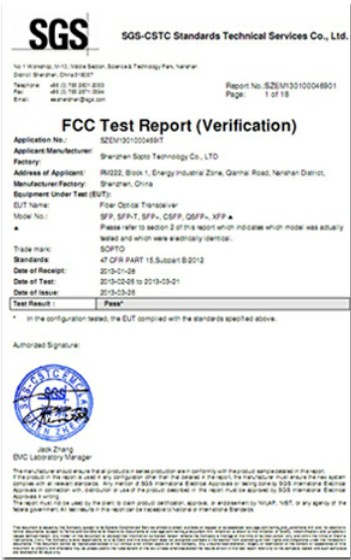

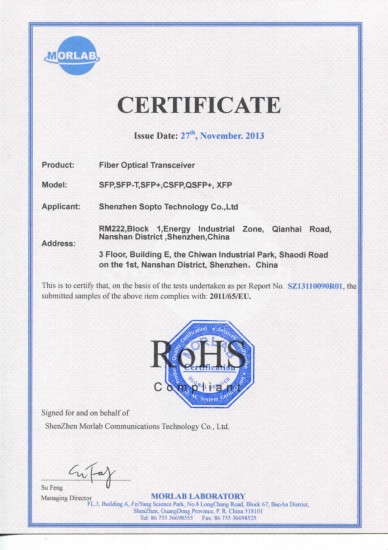
Guarantee
Except products belongs to Bargain Shop section, all products are warranted by SOPTO only to purchasers for resale or for use in business or original equipment manufacturer, against defects in workmanship or materials under normal use (consumables, normal tear and wear excluded) for one year after date of purchase from SOPTO, unless otherwise stated...
Return Policies
Defective products will be accepted for exchange, at our discretion, within 14 days from receipt. Buyer might be requested to return the defective products to SOPTO for verification or authorized service location, as SOPTO designated, shipping costs prepaid. .....
Applications

Sopto supply the best FTTH solutions for your network!
SNS Page


SOPTO Products
- Fiber Optic Transceiver Module
- High Speed Cable
- Fiber Optical Cable
- Fiber Optical Patch Cords
- Splitter CWDM DWDM
- PON Solution
- FTTH Box ODF Closure
- PCI-E Network Card
- Network Cables
- Fiber Optical Adapter
- Fiber Optical Attenuator
- Fiber Media Converter
- PDH Multiplexers
- Protocol Converter
- Digital Video Multiplexer
- Fiber Optical Tools
- Compatible
Related Products
Performance Feature
FTTH Knowledge
Recommended
What is Passive Optical Network?
A passive optical network (PON) is a system that brings optical fiber cabling and signals all or most of the way to the end user. Depending on where the PON terminates, the system can be described as fiber-to-the-curb (FTTC), fiber-to-the-building (FTTB) or fiber-to-the-home (FTTH).
A PON consists of an Optical Line Termination (OLT) at the communication company's office and a number of Optical Network Units (ONUs) near end users. Typically, up to 32 ONUs can be connected to an OLT. The passive simply describes the fact that optical transmission has no power requirements or active electronic parts once the signal is going through the network.
All PON systems have essentially the same theoretical capacity at the optical level. The limits on upstream and downstream bandwidth are set by the electrical overlay, the protocol used to allocate the capacity and manage the connection. The first PON systems that achieved significant commercial deployment had an electrical layer built on Asynchronous Transfer Mode (ATM, or "cell switching") and were called "APON." These are still being used today, although the term "broadband PON" or BPON is now applied. APON/BPON systems typically have downstream capacity of 155 Mbps or 622 Mbps, with the latter now the most common. Upstream transmission is in the form of cell bursts at 155 Mbps.
Multiple users of a PON could be allocated portions of this bandwidth. A PON could also serve as a trunk between a larger system, such as a CATV system, and a neighborhood, building, or home Ethernet network on coaxial cable.
The successor to APON/BPON is GPON, which has a variety of speed options ranging from 622 Mbps symmetrical (the same upstream/downstream capacity) to 2.5Gbps downstream and 1.25Gbps upstream. GPON is also based on ATM transport. GPON is the type of PON most widely deployed in today's fiber-to-the-home (FTTH) networks in new installations and is generally considered suitable for consumer broadband services for the next five to 10 years. From GPON, the future could take two branches:
1) 10 GPON would increase the speed of a single electrical broadband feed to 10G;
2) WDM-PON would use wavelength-division multiplexing (WDM) to split each signal into 32 branches.
A rival activity to GPON is Ethernet PON (EPON), which uses Ethernet packets instead of ATM cells. EPON should be cheaper to deploy, according to supporters, but it has not garnered the level of acceptance of GPON, so it is not clear how EPON will figure in the future of broadband access.
For more information, please browse our website or contact a Sopto representative by calling 86-755-36946668, or by sending an email to info@sopto.com.