-

- Sopto Home
-

- Special Topic
-
- Fiber Optics knowledge
-
- Fiber Optic Network Optical Wavelength Transmission Bands

Fiber Optics knowledge
- Maintained Methods of Fusion Splicer Parts
- How to Use the Fiber Optic Cleaver?
- What are Fixed Attenuators & Variable Attenuators?
- Deployable Fiber Optic Systems for Harsh Mining Environments
- Developing Miniature Fiber Optic Cable Has Become the Trend
- Fiber Optic Cleaning Procedures
- 6 Steps to Selecting a Fiber Optic Cable
- Signal Attenuation Introduction
- How Fiber Transmission Works?
SOPTO Special Topic
Certificate
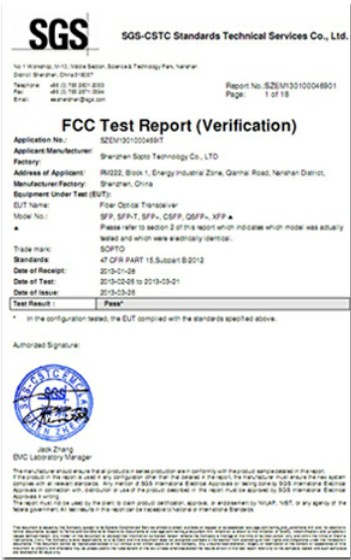
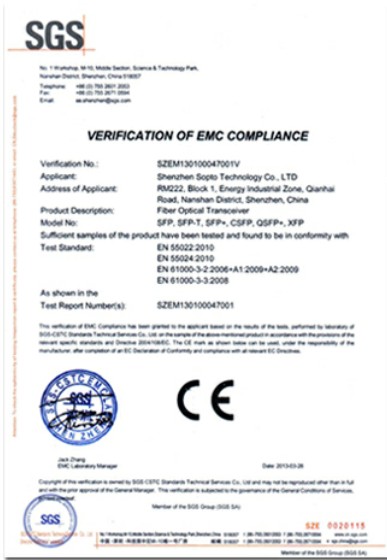
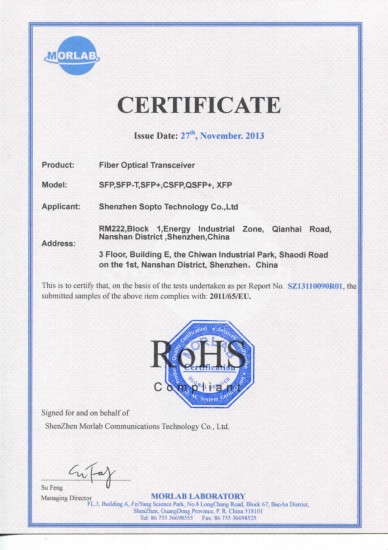
Guarantee
Except products belongs to Bargain Shop section, all products are warranted by SOPTO only to purchasers for resale or for use in business or original equipment manufacturer, against defects in workmanship or materials under normal use (consumables, normal tear and wear excluded) for one year after date of purchase from SOPTO, unless otherwise stated...
Return Policies
Defective products will be accepted for exchange, at our discretion, within 14 days from receipt. Buyer might be requested to return the defective products to SOPTO for verification or authorized service location, as SOPTO designated, shipping costs prepaid. .....
Applications
Fiber Optis can be used in so many fields:
Data Storage Equipment
Interconnects,Networking
Gigabit Ethernet
FTTx, HDTV,CATV
Aerospace & Avionics
Data Transfer Tests
Network Equipment
Broadcast Automotive
Electronics,Sensing
Oil & Gas, Imaging
Outside Plant,Central Office
Harsh Environment
Data Transmission
Illumination,Institutions
Ship to Shore,Education
Simulation,Military,Space
Unmanned Aerial Vehicles
Semiconductor Equipment
Diagnostics & Troubleshooting
Premise Networks Carrier Networks
Independent Telecommunication Providers
SNS Page


SOPTO Products
- Fiber Optic Transceiver Module
- High Speed Cable
- Fiber Optical Cable
- Fiber Optical Patch Cords
- Splitter CWDM DWDM
- PON Solution
- FTTH Box ODF Closure
- PCI-E Network Card
- Network Cables
- Fiber Optical Adapter
- Fiber Optical Attenuator
- Fiber Media Converter
- PDH Multiplexers
- Protocol Converter
- Digital Video Multiplexer
- Fiber Optical Tools
- Compatible
Related Products
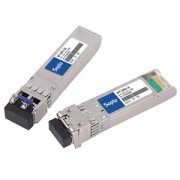 10G SFP+ Transceiver
 40G QSFP+ Transceiver
Performance Feature
Fiber Optics knowledge
Recommended
Fiber Optic Network Optical Wavelength Transmission Bands
As fiber optic networks have developed for longer distances, higher speeds and wavelength-division multiplexing (WDM), fibers have been used in new wavelength ranges, now called "bands," where fiber and transmission equipment can operate more efficiently. Singlemode fiber transmission began in the "O-band" just above the cutoff wavelength of the SM fiber developed to take advantage of the lower loss of the glass fiber at longer wavelengths and availablility of 1310 nm diode lasers. (Originally SM fibers were developed for 850 nm lasers where the fiber core was about half what it is for today's conventional SM fiber (~5 microns as opposed to ~8-9 microns at 1310 nm.)
To take advantage of the lower loss at 1550 nm, fiber was developed for the C-band. As links became longer and fiber amplifiers began being used instead of optical-to-electronic-to-optical repeaters, the C-band became more important. With the advent of DWDM (dense wavelength-division multiplexing) which allowed multiple signals to share a single fiber, use of this band was expanded. Development of new fiber amplifiers (Raman and thullium-doped) promise to expand DWDM upward to the L-band.
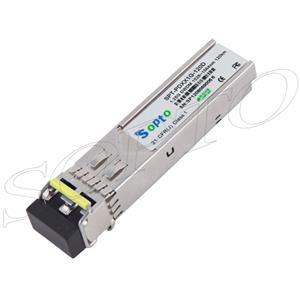
1.25G 120km DWDM SFP Optical Transceiver
Several low-cost versions of WDM are in use, generally referred to as Coarse WDM or CWDM. Most do not work over long distances so do not require amplification, broading the wavelength choice. The most popular is FTTH PON systems, sending signals downstream to users at 1490 nm and using low cost 1310 nm transmission upstream. Early PON systems also use 1550 downstream for TV, but that is being replaced by IPTV on the downstream digital signal at 1490 nm. Other systems use a combination of S, C and L bands to carry signals because of the lower attenuation of the fiber. Some systems even use lasers at 20 nm spacings over the complete range of 1260 to 1660 nm but only with low water peak fibers.
Manufacturers have been able to make fiber with low-water peaks, opening up a new transmission band (E-band), but it has not yet proven useful except for CWDM. It is probably mostly useful as an extension of the O-band but few applications have been proposed and it is very energy-intensive for manufacture.
DWDM Band Wavelength Range Table:
|
Band Name |
Wavelengths |
Description |
|
O-band |
1260 – 1360 nm |
Original band, PON upstream |
|
E-band |
1360 – 1460 nm |
Water peak band |
|
S-band |
1460 – 1530 nm |
PON downstream |
|
C-band |
1530 – 1565 nm |
Lowest attenuation, original DWDM band, compatible with fiber amplifiers, CATV |
|
L-band |
1565 – 1625 nm |
Low attenuation, expanded DWDM band |
|
U-band |
1625 – 1675 nm |
Ultra-long wavelength |
For more info, please browse our website.