-

- Sopto Home
-

- Special Topic
-
- Fiber Optics knowledge
-
- Exploring the Anatomy of a Fiber Optic Cable

Fiber Optics knowledge
- Maintained Methods of Fusion Splicer Parts
- How to Use the Fiber Optic Cleaver?
- What are Fixed Attenuators & Variable Attenuators?
- Deployable Fiber Optic Systems for Harsh Mining Environments
- Developing Miniature Fiber Optic Cable Has Become the Trend
- Fiber Optic Cleaning Procedures
- 6 Steps to Selecting a Fiber Optic Cable
- Signal Attenuation Introduction
- How Fiber Transmission Works?
SOPTO Special Topic
Certificate
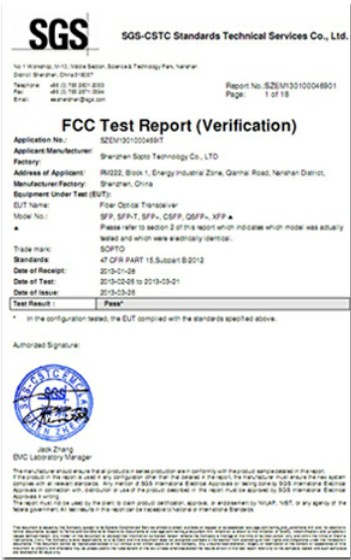
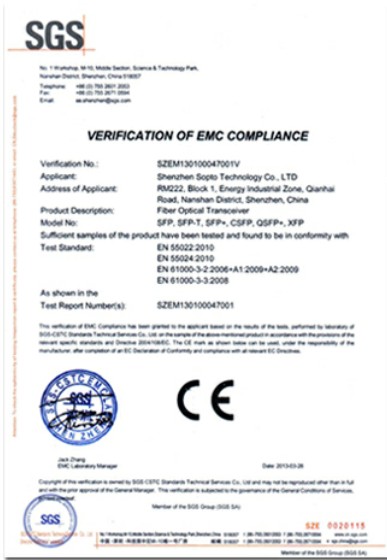
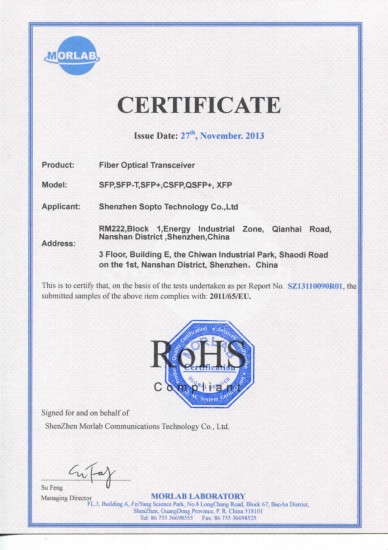
Guarantee
Except products belongs to Bargain Shop section, all products are warranted by SOPTO only to purchasers for resale or for use in business or original equipment manufacturer, against defects in workmanship or materials under normal use (consumables, normal tear and wear excluded) for one year after date of purchase from SOPTO, unless otherwise stated...
Return Policies
Defective products will be accepted for exchange, at our discretion, within 14 days from receipt. Buyer might be requested to return the defective products to SOPTO for verification or authorized service location, as SOPTO designated, shipping costs prepaid. .....
Applications
Fiber Optis can be used in so many fields:
Data Storage Equipment
Interconnects,Networking
Gigabit Ethernet
FTTx, HDTV,CATV
Aerospace & Avionics
Data Transfer Tests
Network Equipment
Broadcast Automotive
Electronics,Sensing
Oil & Gas, Imaging
Outside Plant,Central Office
Harsh Environment
Data Transmission
Illumination,Institutions
Ship to Shore,Education
Simulation,Military,Space
Unmanned Aerial Vehicles
Semiconductor Equipment
Diagnostics & Troubleshooting
Premise Networks Carrier Networks
Independent Telecommunication Providers
SNS Page


SOPTO Products
- Fiber Optic Transceiver Module
- High Speed Cable
- Fiber Optical Cable
- Fiber Optical Patch Cords
- Splitter CWDM DWDM
- PON Solution
- FTTH Box ODF Closure
- PCI-E Network Card
- Network Cables
- Fiber Optical Adapter
- Fiber Optical Attenuator
- Fiber Media Converter
- PDH Multiplexers
- Protocol Converter
- Digital Video Multiplexer
- Fiber Optical Tools
- Compatible
Related Products
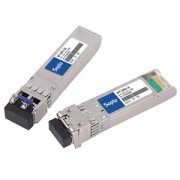 10G SFP+ Transceiver
 40G QSFP+ Transceiver
Performance Feature
Fiber Optics knowledge
Recommended
Exploring the Anatomy of a Fiber Optic Cable
What's really inside a fiber optic cable? That's a question that most customers of fiber optic cable suppliers want to know. Fiber optic is the communications medium that works by sending optical signals down hair-thin strands of extremely pure glass or plastic fiber. Fiber optic cables are capable of carrying high volume of data over long distances. This article is written to take a peek inside fiber optic cables. Starting at the center and working our way outside.
A standard fiber optic cable is comprised of five specific parts:
Core
A fiber optic's
center is made of glass, and this tube carries the cable's light signals Depending on the type of fiber optic cable (single more of multimode), the core varies in size Single mode fibers consist of a tiny glass core that typically has a diameter between 8.3 and 10 microns. This type of cable is used for telephone and CATV with laser sources at 1300 and 1550nm because it has a lower loss and virtually infinite bandwidth. For multi-mode fibers, the core is larger.
Their core size ranges from 5 to 7 times larger than a single mode core. With a diameter ranging between 50 to 62.5 microns, it supports the transmission of multiple modes (rays) of light and perfect for high data applications. Multimode is generally used with LED source at wavelengths of 850 and 1300nm for slower local area networks (LANs) and lasers at 850 (VCSELs) and 1310nm (Fabry-Perot lasers ore FP Lasers) for networks running at gigabyte per seconds or more. Multi-mode cables are typically used over shorter distances than single mode fiber optic cables.
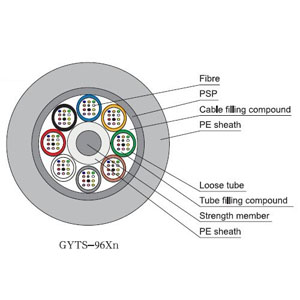
Loose Tube Outdoor Optical cable
Cladding layer
The core is surrounded by an optical material called the "cladding" that traps the light in the core using an optical technique called When transmitting data (especially over long distances), light rays can reflect off each "total internal reflection." other and travel in different directions The cladding keeps those signals straight.
Buffer
Buffer is made to protect fiber from moisture and physical damage. The buffer is what one strips off the fiber for termination or splicing More often than not, the buffer is made of Plastic.
Jacket
The fiber optic's cable exterior is typically made of tough, durable polyurethane Its’ job is to protect the overall integrity of the fiber optic cable The jacket is the first line of defense in a fiber optic cable Routing cables can put stresses on a fiber optic cable and a jacket sometimes contains an extra layer to avoid these potential hazards.
Water Barrier
Common water barriers for ordinary cable include: an axially laid aluminum foil / polyethylene laminated film immediately inside the polyurethane of polyethylene plastic sheaths and / or the use of moisture resistant compounds around the fibers.
For more info, please browse our website. For purchasing fiber optic assembly products, please contact a Sopto representative by calling 86-755-36946668, or by sending an email to info@sopto.com.