


FTTH Knowledge
- Solving the FTTH Rollout Problem in Multiple Dwelling Units
- WDM PON Introduction FAQ
- A Simple Overview of Optical Power Meter
- ODN is based on PON FTTH Optical Cable Network of the Device
- Using an OTDR to be an Expert in Fiber Link Testing
- How FTTH Broadband Works?
- Connections among Fiber Terminal Boxes & Patch Cables & Pigtails
- Easy to Install a Fiber Terminal Box
- What is Arrayed Waveguide Grating?
SOPTO Special Topic
Certificate
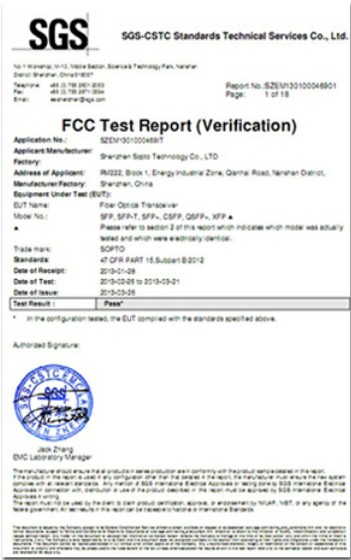

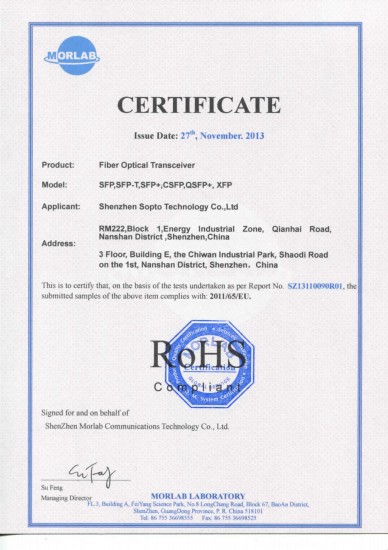
Guarantee
Except products belongs to Bargain Shop section, all products are warranted by SOPTO only to purchasers for resale or for use in business or original equipment manufacturer, against defects in workmanship or materials under normal use (consumables, normal tear and wear excluded) for one year after date of purchase from SOPTO, unless otherwise stated...
Return Policies
Applications

Sopto supply the best FTTH solutions for your network!
SNS Page


SOPTO Products
- Fiber Optic Transceiver Module
- High Speed Cable
- Fiber Optical Cable
- Fiber Optical Patch Cords
- Splitter CWDM DWDM
- PON Solution
- FTTH Box ODF Closure
- PCI-E Network Card
- Network Cables
- Fiber Optical Adapter
- Fiber Optical Attenuator
- Fiber Media Converter
- PDH Multiplexers
- Protocol Converter
- Digital Video Multiplexer
- Fiber Optical Tools
- Compatible
Related Products
Performance Feature
Recommended
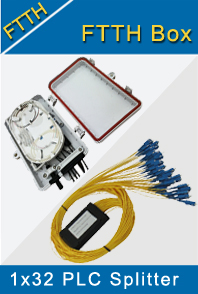
- Characteristics of Active and Passive Optical Networks
There are two important types of systems that make FTTH broadband connections possible. These are active optical networks and passive optical networks.
- JDSU Cleaning and Testing Kits
JDSU's all-in-one fiber optic test kits, providing network technicians with a simple way to avoid one of the leading causes of network downtime: contaminated, or “dirty,” fiber.
- What are the Advantages to FTTH broadband Connections?
A key advantage to FTTH - also called FTTP, for "fiber to the premises" broadband - is that it provides for far faster connection speeds and carrying capacity than twisted pair conductors, DSL or coaxial cable.
- Crimping Tool Overview
The crimping tool is used for creating a joint between two metal pieces or other materials with good malleability. The joint formed by crimping needs to be strong to ensure that the application works properly.
- How OTDR Works in Basic Terms?
OTDR inner workings can be very complex but i would like to try and describe how it works in basic terms. They use the actual properties of the fiber cable as they respond to light.
- How to Operate a Crimp Tool?
A crimping tool is an essential part of the crimping process, the other parts being the terminal and wire. Terminal size is largely universal and can accept many sizes of gauged wire, which can also vary widely within the same nominative value.
- Advantages of Fiber Optic Transmission
The basic architecture of the fiber optic communication is a "fiber transmitter “and” receiver fiber unit converter...
- When do You Need OTDRs?
If you are installing an outside plant network such as a long distance network or a long campus LAN with splices between cables, you will want an OTDR (optical time-domain reflectometer) to check if the fibers and splices are good.
- Gigabit FTTH Trend
The Gigabit FTTH trend is gaining significant attention, thanks in large part to Google and their Google Fiber initiative. Since Google launched its own fiber-to-the-home initiative, promising to build open-access fiber networks...
- Working Principle and Characteristics of OTDR
OTDR, the full name of which is Optical Time Domain Reflectometer, is a precise optoelectronic integrated fiber optic test equipment that produced by use of the backscatter during the Rayleigh scattering and Fresnel reflecting in the optical transmission.
- Optical WDM in Fiber Optic Network
Optical WDM networks are networks that deploy optical WDM fiber links where each fiber link carries multiple wavelength channels.
- Useful feeder cable in FTTH
The feeder cabling runs from the Access Node to the first or primary Fiber Concentration Point (FCP).
- Best Practices for Testing FTTH Deployments
Deploying fiber to the home requires learning a new set of network testing practices. Here’s a quick summary of what operators need to know and when they need to know it.
- Fiber Installation Testing
Fiber connectors are widely known as the weakest points in a network. The more connections in a network, the greater is the potential for problems caused by improper handling during installation, operation, expansion and maintenance.
- Turn-up tests
After acceptance testing, the optical network terminals (ONTs) can be installed in the customer premises. With PON technology, an ONT’s 1310nm wavelength is activated only by the 1490nm signal from the OLT. Therefore, to measure the output power of all wa
- Turning up Services
Video service quality is ultimately determined by the end user or subscriber. Video quality of experience (QoE) is a subjective concept with components that are nearly impossible to measure in a practical, operational manner.
- Sopto OLT Performance Overview
With growing network services such as HDTV, IPTV, voice-over-IP (VoIP) and Multimedia broadband applications, the demand of broadband has increased tremendously.
- Sopto Fiber Optic Connectivity Solutions
In the broadband communication, the fiber optic network deployment is increasingly applied to fulfill the cloud application and high-demand multimedia streaming needs nowadays.
- GEPON ONU with one GE + one FE Port
SOPTO SPT-ONU-404H is a GEPON Optical Network Unit (ONU) equipped with one GEPON port, one Gigabit and one Fast Ethernet RJ-45 interface.
- Why is WDM Technology So Popular Today?
Nowadays the voice, video, and data networks are becoming more complex and requiring more bandwidth and faster transmission rates over ever increasing distances. To fulfill these demands, network managers are relying more about fiber optics.