-

- Sopto Home
-

- Special Topic
-
- FTTH Knowledge
-
- Things You Should Know About WDM Filter

FTTH Knowledge
- Solving the FTTH Rollout Problem in Multiple Dwelling Units
- WDM PON Introduction FAQ
- A Simple Overview of Optical Power Meter
- ODN is based on PON FTTH Optical Cable Network of the Device
- Using an OTDR to be an Expert in Fiber Link Testing
- How FTTH Broadband Works?
- Connections among Fiber Terminal Boxes & Patch Cables & Pigtails
- Easy to Install a Fiber Terminal Box
- What is Arrayed Waveguide Grating?
SOPTO Special Topic
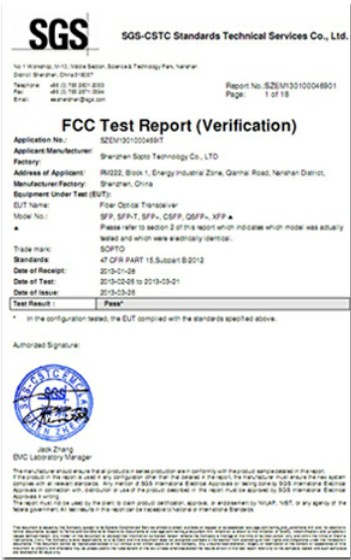
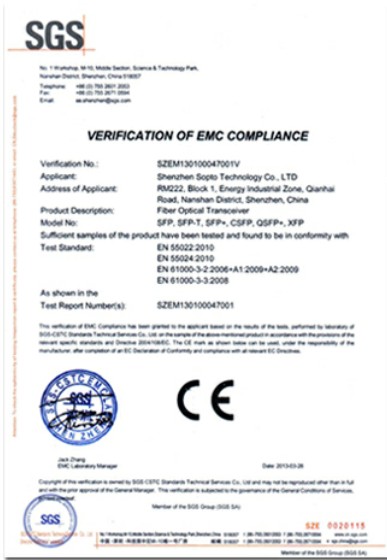
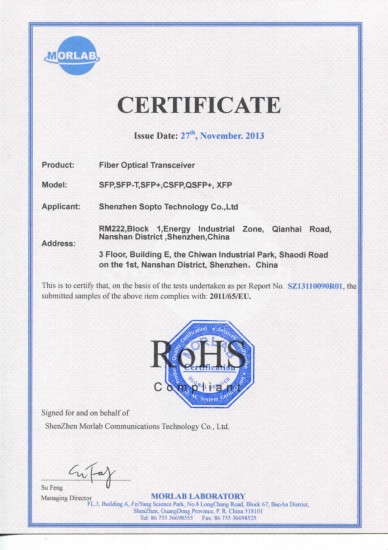
Certificate
Guarantee
Except products belongs to Bargain Shop section, all products are warranted by SOPTO only to purchasers for resale or for use in business or original equipment manufacturer, against defects in workmanship or materials under normal use (consumables, normal tear and wear excluded) for one year after date of purchase from SOPTO, unless otherwise stated...
Return Policies
Defective products will be accepted for exchange, at our discretion, within 14 days from receipt. Buyer might be requested to return the defective products to SOPTO for verification or authorized service location, as SOPTO designated, shipping costs prepaid. .....
Applications

Sopto supply the best FTTH solutions for your network!
SNS Page


SOPTO Products
- Fiber Optic Transceiver Module
- High Speed Cable
- Fiber Optical Cable
- Fiber Optical Patch Cords
- Splitter CWDM DWDM
- PON Solution
- FTTH Box ODF Closure
- PCI-E Network Card
- Network Cables
- Fiber Optical Adapter
- Fiber Optical Attenuator
- Fiber Media Converter
- PDH Multiplexers
- Protocol Converter
- Digital Video Multiplexer
- Fiber Optical Tools
- Compatible
Related Products
Performance Feature
FTTH Knowledge
Recommended
Things You Should Know About WDM Filter
The optical devices most often used to selectively transmit certain wavelengths are called filter, which covers a broad range of devices, including fiber optical attenuators. Filters play important roles in Wavelength Division Multiplexing(WDM) systems, although other technologies also may be used. WDM Filters can separate or combine optical signals carried on different wavelengths in a cost-effective manner.
In the world of optics, “filter” often is a broad term applied to components that filter out part of the incident light and transmit the rest. In WDM systems, the wavelengths that are not transmitted through the filter normally are reflected so they can go elsewhere in the system. Such filters are like mirror shades or one-way mirrors, which reflect most incident light, but transmit enough for you to see through them.
Common optical filters accommodate channel growth without service interruption. In addition, the filters’ low network-to-express loss allows stacking, which is essential for scaling new wavelengths. Most filters are equipped with an express port to pass through non-dropped/added WDM channels. Interconnecting express ports of two filters forms an Optical Add/Drop Multiplexer (OADM) with east/west fiber connections. High filter isolation eliminates disruptive “shadow” wavelengths and allows channels that have been dropped at a node to be used elsewhere downstream.
Interference filters and other technologies can be used to separate and combine wavelengths in WDM systems. Several approaches are now competing for WDM applications, some technologies appear to have advantages for certain types of WDM systems, but the field is still evolving, and no single approach dominates. Although these technologies work in different ways, they can achieve the common goal of optical multiplexing and demultiplexing.
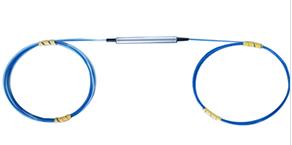
There are three competing filtration technologies: Thin Film Filters (TFF), Array Waveguides (AWG), and Fiber Bragg Gratings (FBG). Thin film filters were adopted very early and have been widely deployed because they have the unique attributes that meet the stringent requirements of optical communication systems.
Wide band WDM filters – They are used in EDFAs as pump couplers and supervisory channel monitors. This family of filters covers a wide variety of other filters. Their applications range from CWDM (Coarse WDM), to bi-directional transceivers, to 1310/1490/1550 nm tri-band filters for fiber to the home (FTTH).
Fiber Bragg gratings work similarly by reflecting specific wavelengths. WDM applications require the use of many interference filters or fiber gratings, with each one picking off an individual wavelength or group of wavelengths. FTTX Filter WDM module is based on thin film filter technology.
Sopto Filter-Based WDM product family covers following wavelength windows commonly used in optical fiber systems: 1310/1550nm (for WDM or DWDM optical communications), 1480/1550nm (for high-power DWDM optical amplifier/EDFA), 1510/1550nm (for DWDM multi-channel optical networks) and 980/1550nm (for high performance DWDM optical amplifier/EDFA) and 1310/1490/1550nm (for PON/FTTX/test instrument).
Compared with fused fiber WDM couplers, filter-based WDM components have much wider operating bandwidth, lower insertion loss, higher power handling, high isolation, etc. For more information, please contact a Sopto representative by calling 86-755-36946668, or by sending an email to info@sopto.com.