-

- Sopto Home
-

- Special Topic
-
- Twinax Cable Knowledge
-
- Difference between a Network Cable and an Ethernet Cable

Twinax Cable Knowledge
- Cable Labeling as Part of Data Center Management
- How to Correctly Run cables On Servers in a Data Center?
- 4 Realities You Should Consider 10G Ethernet for Your Business
- Is it finally the end of copper?
- Why We Need Both 40G and 100G Ethernet Cable?
- What is Twisted Pair Cable?
- Benefits of Twisted Pair Cable Construction
- Why Copper Is Used in Cables?
- A Brief Look at Ethernet Cable Construction
SOPTO Special Topic
Certificate
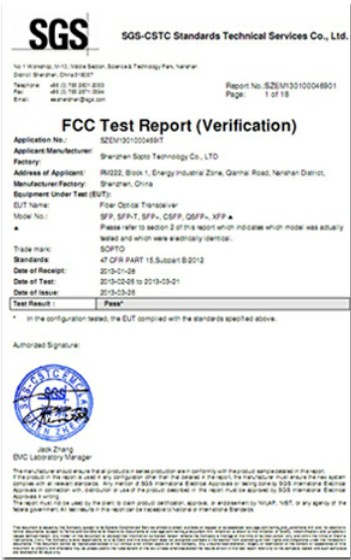
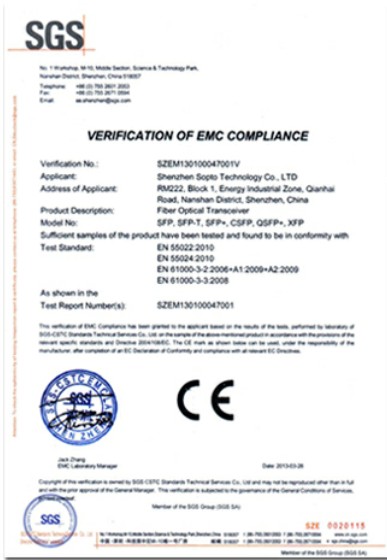
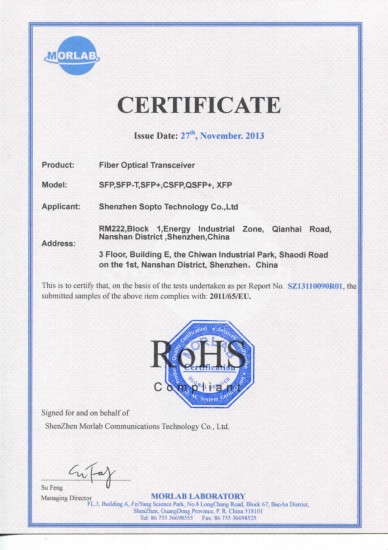
Guarantee
Except products belongs to Bargain Shop section, all products are warranted by SOPTO only to purchasers for resale or for use in business or original equipment manufacturer, against defects in workmanship or materials under normal use (consumables, normal tear and wear excluded) for one year after date of purchase from SOPTO, unless otherwise stated...
Return Policies
Defective products will be accepted for exchange, at our discretion, within 14 days from receipt. Buyer might be requested to return the defective products to SOPTO for verification or authorized service location, as SOPTO designated, shipping costs prepaid. .....
Applications
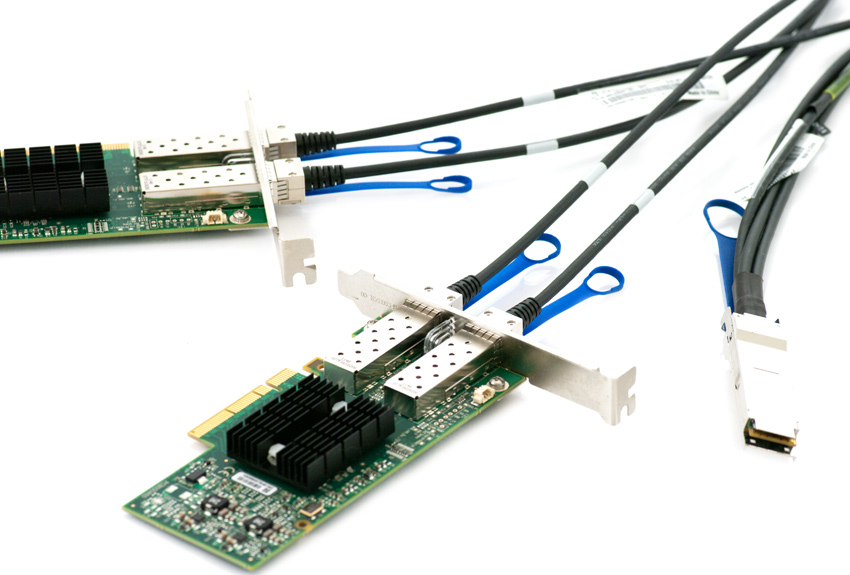 Twinax Cables are mainly used with PCI or PCI-E Card for the short distance interconnection in the server room.
SNS Page


SOPTO Products
- Fiber Optic Transceiver Module
- High Speed Cable
- Fiber Optical Cable
- Fiber Optical Patch Cords
- Splitter CWDM DWDM
- PON Solution
- FTTH Box ODF Closure
- PCI-E Network Card
- Network Cables
- Fiber Optical Adapter
- Fiber Optical Attenuator
- Fiber Media Converter
- PDH Multiplexers
- Protocol Converter
- Digital Video Multiplexer
- Fiber Optical Tools
- Compatible
Related Products
Performance Feature
Stable Transmission Speed
Reliable Transmission
Various Length Selection
Wider Operating Temperature
Good for HPC
Good for Data Center
Twinax Cable Knowledge
Recommended
Difference between a Network Cable and an Ethernet Cable
Computer suppliers often advertise "Ethernet cable" for sale. But what is Ethernet cable? Ethernet is the name of a set of standards for networking specifically related to the physical elements of a wired network and how they handle data. Ethernet cable is network cable.
The Ethernet cable advertised in computer stores is, in fact, Unshielded Twisted Pair, or UTP, cable. This is the most common type of cable used in networks. As almost all networks follow Ethernet standards for cabling, UTP has become the most closely identified cable for Ethernet, and is therefore called Ethernet cable. By a similar shorthand, the connector on a network cable is often called the Ethernet connector and the network socket on a computer is usually called the Ethernet socket. The Ethernet recommendations do not call any of these pieces of equipment by those names.
Ethernet was created by Xerox in the 1970s. It is now an open standard managed by the Institute of Electrical and Electronics Engineers. An open standard is one that is freely distributed. Anyone can get a copy of an Ethernet standard because it is not a design for a piece of equipment but a recommendation for how that equipment should be configured in order to connect with similar equipment produced by other manufacturers.
The Institute of Electrical and Electronics Engineers, or the IEEE, is a New York-based standards body specializing in standards for networks -- both wired and wireless. The IEEE organizes its research in departments called working groups. Each working group specializes in defining standards for one aspect of networking. Each working group is assigned a code and all that group's recommendations are published with that code followed by a letter to make each document name unique. The IEEE working group for Ethernet has the code 802.3. Any product claiming compliance with 802.3 can be labeled "Ethernet."
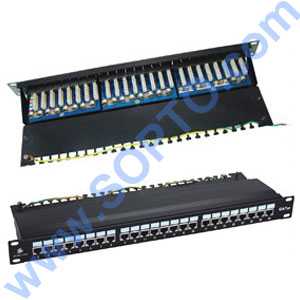
UTP is the best-known Ethernet cable. The cable type is manufactured in several different grades, with the most common category for networks called Cat 5. Of the Cat 5 category family, the Cat 5E is the most popular choice for new cable purchases. However, not all Ethernet networks use UTP, which shows that giving UTP the name "Ethernet cable" is a misnomer. Coaxial cable is also implemented for Ethernet networks. High-specification, high-speed Ethernet networks use fiber optic as the physical medium.
For more info, please browse our website. For purchasing network cables or Ethernet high speed cables, please contact a Sopto representative by calling 86-755-36946668, or by sending an email to info@sopto.com.