-

- Sopto Home
-

- Special Topic
-
- Twinax Cable Knowledge
-
- Overhead Cabling Can Reduce Data Center Energy Costs

Twinax Cable Knowledge
- Cable Labeling as Part of Data Center Management
- How to Correctly Run cables On Servers in a Data Center?
- 4 Realities You Should Consider 10G Ethernet for Your Business
- Is it finally the end of copper?
- Why We Need Both 40G and 100G Ethernet Cable?
- What is Twisted Pair Cable?
- Benefits of Twisted Pair Cable Construction
- Why Copper Is Used in Cables?
- A Brief Look at Ethernet Cable Construction
SOPTO Special Topic
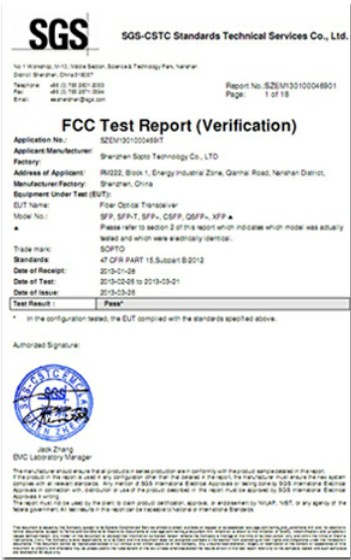
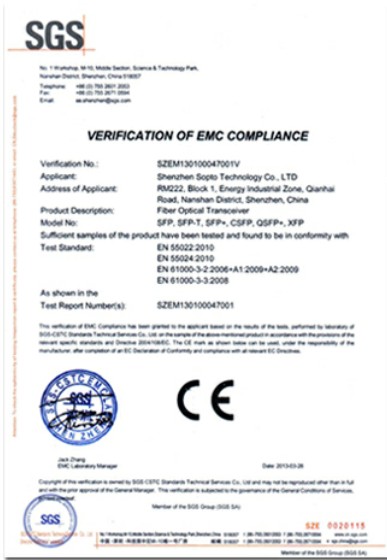
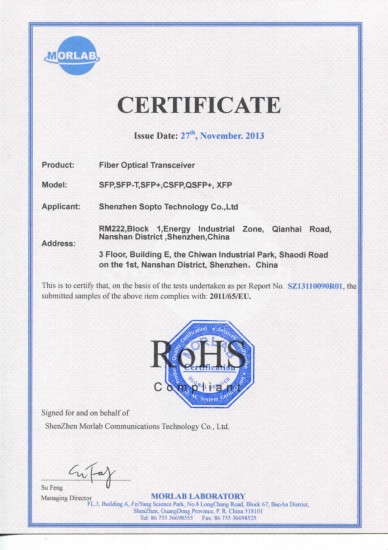
Certificate
Guarantee
Except products belongs to Bargain Shop section, all products are warranted by SOPTO only to purchasers for resale or for use in business or original equipment manufacturer, against defects in workmanship or materials under normal use (consumables, normal tear and wear excluded) for one year after date of purchase from SOPTO, unless otherwise stated...
Return Policies
Defective products will be accepted for exchange, at our discretion, within 14 days from receipt. Buyer might be requested to return the defective products to SOPTO for verification or authorized service location, as SOPTO designated, shipping costs prepaid. .....
Applications
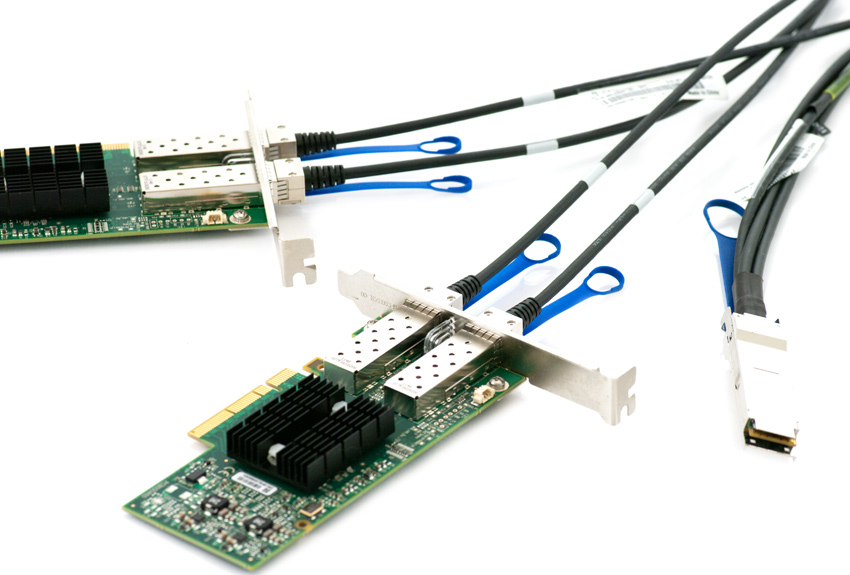 Twinax Cables are mainly used with PCI or PCI-E Card for the short distance interconnection in the server room.
SNS Page


SOPTO Products
- Fiber Optic Transceiver Module
- High Speed Cable
- Fiber Optical Cable
- Fiber Optical Patch Cords
- Splitter CWDM DWDM
- PON Solution
- FTTH Box ODF Closure
- PCI-E Network Card
- Network Cables
- Fiber Optical Adapter
- Fiber Optical Attenuator
- Fiber Media Converter
- PDH Multiplexers
- Protocol Converter
- Digital Video Multiplexer
- Fiber Optical Tools
- Compatible
Related Products
Performance Feature
Stable Transmission Speed
Reliable Transmission
Various Length Selection
Wider Operating Temperature
Good for HPC
Good for Data Center
Twinax Cable Knowledge
Recommended
Overhead Cabling Can Reduce Data Center Energy Costs
A raised floor to house cabling may be the most common method of cooling data center equipment, but it’s far from the most energy efficient. Increased fan power, oversized cooling units, increased pump power and lower cooling set points are needed to offset cable blockage and air leakage problems caused by this configuration.
Cable configuration
Cold air forced underneath the floor cools cables can lead to hot spots, jammed plenums and reduced cooling system efficiency. In fact, cable cutouts in raised floors required to provide access to racks and PDUs contributes to a cold air leakage of 37%.
Many new data centers choose instead to lay cables on hard floor and cool servers with in-row, overhead or room air conditioning with hot aisle containment.
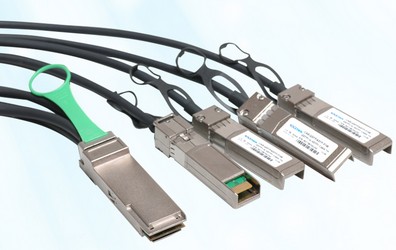
But data center owners are increasingly eyeing overhead cable trays for network data and power cabling. Not only does the system lower cooling fan and power pump consumption by 24% compared to the raised floor system – translating into significant cost savings – a modular overhead tray layout facilitates regular cable maintenance.
Energy analysis
Under-floor cabling wastes energy in three ways. Older, unused cables are frequently left in place to minimize downtime during installation of new network or power cables. The resulting jam of excess cables under the floor blocks air flow which makes it hard to cool servers and contributes to hot spots in the data center. Also, cutouts in floor tiles to feed cables into the bottom of racks as well as those required for PDU input conductor connections are significant sources of cold air leaks.
An overhead system can contribute to energy savings by lowering fan losses and pump losses. In addition, energy cost savings can be realized when the chilled water supply temperature is increased.
Creating a hypothetical 1MW data center at 100% load (i.e., assumed to house 500 IT racks at an average power density of 2kW/rack) allowed for analysis of savings in moving network and power cables to an overhead cable tray system.
The results showed that leakage – caused most significantly by cable cutouts behind IT racks (33%) – was reduced from 55% to 13%. The reduction in leakage causes the computer room air handler (CRAH) return temperatures to be raised, which in turn increases the cooling capacity for each individual CRAH unit. The number of CRAH units was reduced from 42 to 31 in the test center, leading to the estimated 24% savings in fan and pump power.
Efficient maintenance
An overhead system also allows for easier cable maintenance by facilitating access to the slew of system cables.
But even an overhead cabling system can lead to cable “spaghetti” – a mass of tangled cables that makes it impossible to find and replace “dead” cable with new cable. As a result, new cable is laid without removing the old, leaving as much as 80% of dead cables in place.
Creating a modular overhead system provides a solution to this potential problem. Data center personnel can more easily sort and plan cable location, integration and removal with multi-level cable tray organization. In addition, the system facilitates the removal of a “dead” cable, since it will not be tangled or buried among a multitude of other cables.
Ultimate savings
In addition to realizing energy savings, data centers would also see a reduction in capital costs for CRAH units (eliminating the 11 additional CRAH units in the hypothetical analysis resulted in an estimated $90,000 savings) as well as the significant expense of a raised floor.
We supply high quality and low power consumption data center twinax cables for you data center communication application. For purchasing these data center twinax cables with low cost or for more products’ information, please contact a Sopto representative by calling 86-755-36946668, or by sending an email to info@sopto.com.