-

- Sopto Home
-

- Special Topic
-
- Twinax Cable Knowledge
-
- Info about Alien Crosstalk and How to Choose the Transmission Me

Twinax Cable Knowledge
- Cable Labeling as Part of Data Center Management
- How to Correctly Run cables On Servers in a Data Center?
- 4 Realities You Should Consider 10G Ethernet for Your Business
- Is it finally the end of copper?
- Why We Need Both 40G and 100G Ethernet Cable?
- What is Twisted Pair Cable?
- Benefits of Twisted Pair Cable Construction
- Why Copper Is Used in Cables?
- A Brief Look at Ethernet Cable Construction
SOPTO Special Topic
Certificate
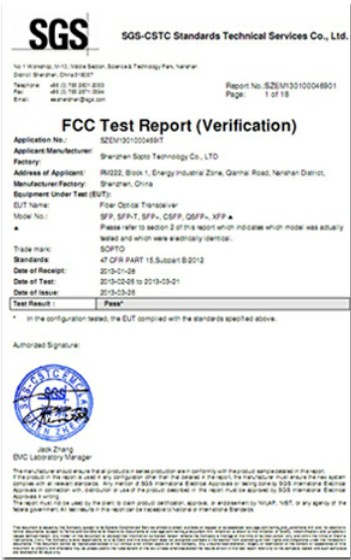
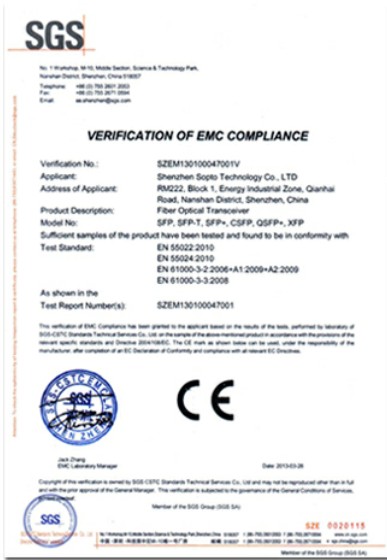
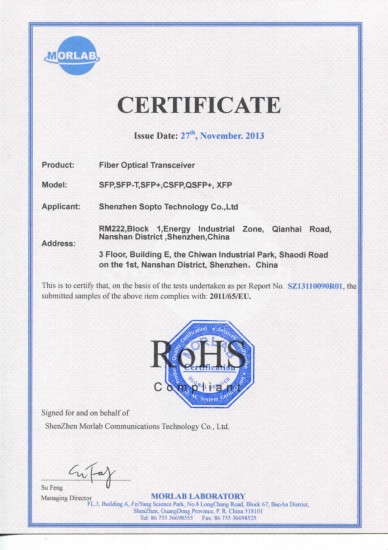
Guarantee
Except products belongs to Bargain Shop section, all products are warranted by SOPTO only to purchasers for resale or for use in business or original equipment manufacturer, against defects in workmanship or materials under normal use (consumables, normal tear and wear excluded) for one year after date of purchase from SOPTO, unless otherwise stated...
Return Policies
Defective products will be accepted for exchange, at our discretion, within 14 days from receipt. Buyer might be requested to return the defective products to SOPTO for verification or authorized service location, as SOPTO designated, shipping costs prepaid. .....
Applications
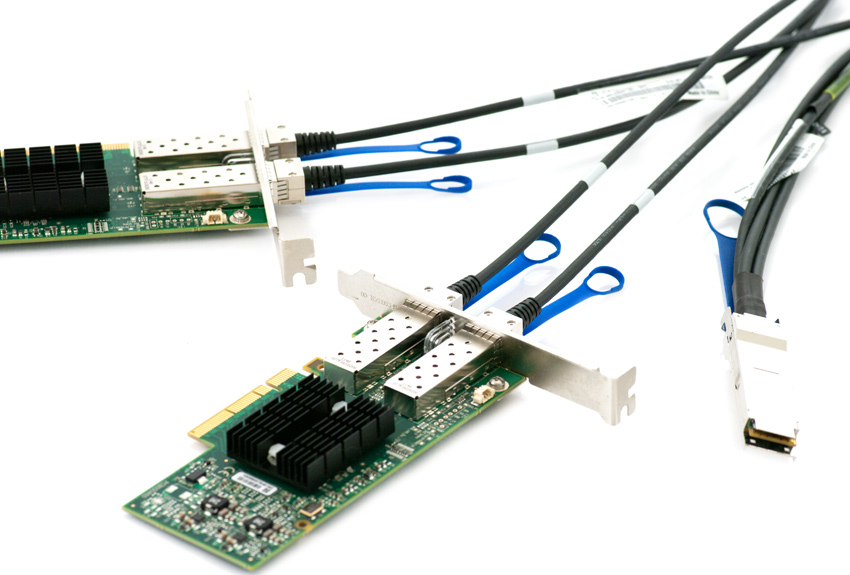 Twinax Cables are mainly used with PCI or PCI-E Card for the short distance interconnection in the server room.
SNS Page


SOPTO Products
- Fiber Optic Transceiver Module
- High Speed Cable
- Fiber Optical Cable
- Fiber Optical Patch Cords
- Splitter CWDM DWDM
- PON Solution
- FTTH Box ODF Closure
- PCI-E Network Card
- Network Cables
- Fiber Optical Adapter
- Fiber Optical Attenuator
- Fiber Media Converter
- PDH Multiplexers
- Protocol Converter
- Digital Video Multiplexer
- Fiber Optical Tools
- Compatible
Related Products
Performance Feature
Stable Transmission Speed
Reliable Transmission
Various Length Selection
Wider Operating Temperature
Good for HPC
Good for Data Center
Twinax Cable Knowledge
Recommended
Info about Alien Crosstalk and How to Choose the Transmission Media
Bigger UTP Cables, Less Alien Crosstalk:
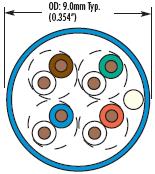
The pending publication of a new TIA standard3 that will allow the maximum overall diameter of twisted-pair cables (regardless of category or construction) to increase from 6.35mm (0.250 in.) to 9mm (0.354 in.) is dramatically and favorably impacting the industry's ability to control alien crosstalk in UTP cabling. By designing UTP cables with larger and thicker overall jackets, cabling experts can provide a means to physically isolate twisted-pairs from adjacent cables.
As a result, new, albeit larger, augmented category 6A compliant UTP cables that exhibit significantly reduced alien crosstalk are available for consideration by system designers who prefer more flexibility and less restrictive cable management practices in the telecommunications closet as compared to UTP cables without improved, alien crosstalk designs.
Alien Crosstalk Conundrum:
Although the definition of alien crosstalk is straightforward, developing field test practices has been a challenge because of the number and complexity of measurements. Since the alien crosstalk characterization of all channels in an installation is entirely impractical, TIA has adopted a "sampling" approach for assessing the alien crosstalk present in a cabling installation.
It is the intent that channels that are representative of worst-case alien crosstalk conditions be tested and if those results exhibit satisfactory performance, then the installation is deemed compliant to alien crosstalk specifications. This sampling method first appeared in the TIA augmented category 6A standard in June of 2005.
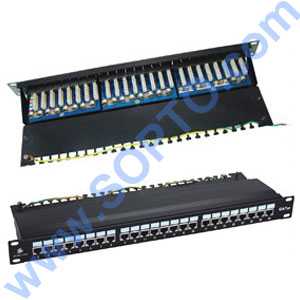
Selection of the installed channels to be tested is based upon evaluating cable density (proximity and bundling), port adjacency at the patch panel, and channel length. It is important to note that specifying cabling systems with alien crosstalk headroom or virtually zero alien crosstalk (augmented category 6A F/UTP and category 7 S/FTP designs) will significantly reduce the need for alien crosstalk field test sampling of the installed cabling plant. See figure 2 for power sum alien near-end crosstalk (PSANEXT loss) data for various cabling types.
Currently, TIA and ISO augmented category 6A standards only contain channel requirements for alien crosstalk and do not contain alien crosstalk requirements for cables and connecting hardware. Therefore, it is especially critical that channels are adequately characterized for 10GBASE-T capacity using simulation models and that they exhibit the minimum allowable performance levels of insertion loss, crosstalk, and return loss required to maintain appropriate signal-to-noise ratios.
How to Choose?
Now, more than ever, cabling media selection is all about evaluating options. The three cable types recommended to support the 10GBASE-T application, along with a summary of their associated features and benefits, are shown as below. Common considerations when selecting media type are cost, ease of installation, and conduit fill.
With more flexibility in cabling options than ever before, there is a 10 Gb/s solution for every budget and for every commercial building environment. Now is the time to get 10Gig ready!
|
Media |
Augmented Category 6A UTP |
Augmented Category 6A F/UTP |
Category 7/Class F S/FTP |
|
Cable Construction |
|
|
|
|
Alien crosstalk |
Exhibits compliant alien crosstalk due to core separation design |
Exhibits virtually zero alien crosstalk due to overall foil construction |
Exhibits virtually zero alien crosstalk due to fully shielded construction |
|
Installation Notes |
Larger overall diameter must be taken into consideration when calculating conduit and pathway fill |
Grounding of the foil in one location from the patch panel in the telecommunications closet to the TGB is required |
Grounding of the shield in one location from the patch panel in the telecommunications closet to the TGB is required |
|
Work Area Interface |
Standard 8-position Modular (RJ-45 style) |
Standard 8-position Modular (RJ-45 style) |
Quadrant-Pair Isolated Connector (non RJ-45 style) |
|
Maximum Recommended Conduit Fill |
60% |
60% |
60% |
|
Shannon Capacity |
Exceeds IEEE 802.3an objectives |
Approximately 18 Gb/s headroom (100% additional capacity based upon PSANEXT loss margin) |
Approximately 22 Gb/s headroom (150% additional capacity based upon PSANEXT loss margin) |
|
Recommended Installation |
Compliant 10Gb/s performance in familiar UTP construction |
Highest density 10Gb/s support when maximum density and conduit fill (e.g. data centers) is desired |
Supports 10Gb/s applications when security is a concern or the need to support broadband video applications in the future is anticipated as well as a potential support of applications beyond 10GBASE-T |
For more info, please browse our website.