-

- Sopto Home
-

- Special Topic
-
- Twinax Cable Knowledge
-
- 10G SFP+ Direct Attach Cable in 10GBase-T Standard

Twinax Cable Knowledge
- Cable Labeling as Part of Data Center Management
- How to Correctly Run cables On Servers in a Data Center?
- 4 Realities You Should Consider 10G Ethernet for Your Business
- Is it finally the end of copper?
- Why We Need Both 40G and 100G Ethernet Cable?
- What is Twisted Pair Cable?
- Benefits of Twisted Pair Cable Construction
- Why Copper Is Used in Cables?
- A Brief Look at Ethernet Cable Construction
SOPTO Special Topic
Certificate

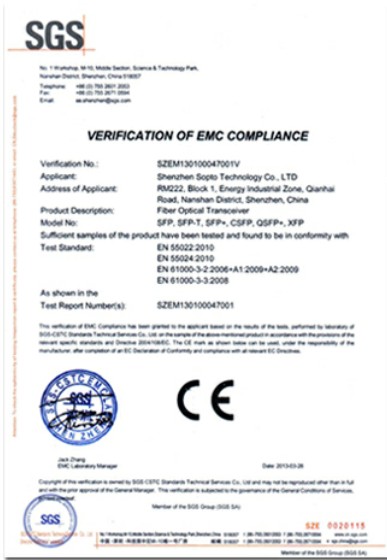
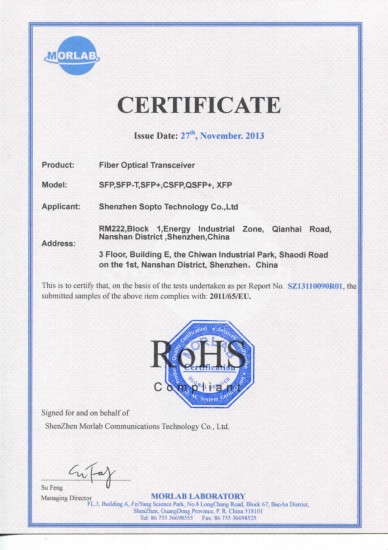
Guarantee
Except products belongs to Bargain Shop section, all products are warranted by SOPTO only to purchasers for resale or for use in business or original equipment manufacturer, against defects in workmanship or materials under normal use (consumables, normal tear and wear excluded) for one year after date of purchase from SOPTO, unless otherwise stated...
Return Policies
Defective products will be accepted for exchange, at our discretion, within 14 days from receipt. Buyer might be requested to return the defective products to SOPTO for verification or authorized service location, as SOPTO designated, shipping costs prepaid. .....
Applications
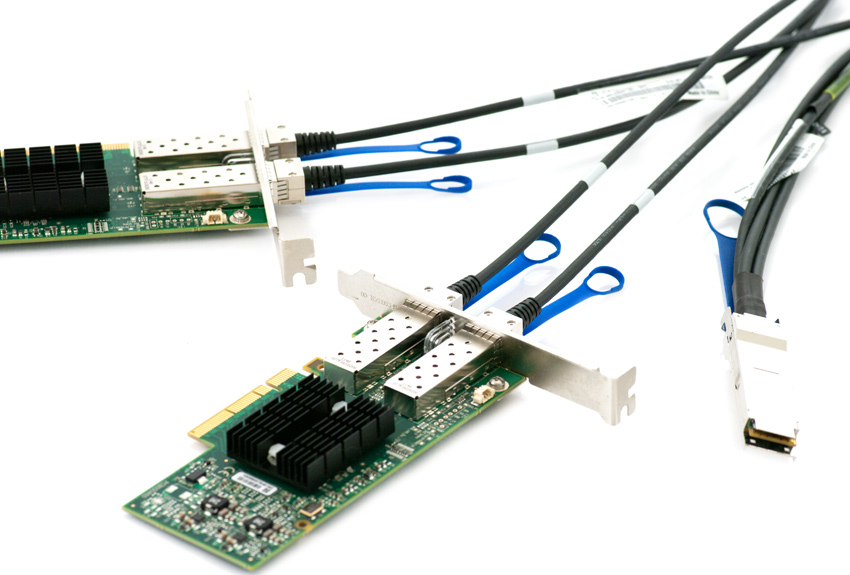 Twinax Cables are mainly used with PCI or PCI-E Card for the short distance interconnection in the server room.
SNS Page


SOPTO Products
- Fiber Optic Transceiver Module
- High Speed Cable
- Fiber Optical Cable
- Fiber Optical Patch Cords
- Splitter CWDM DWDM
- PON Solution
- FTTH Box ODF Closure
- PCI-E Network Card
- Network Cables
- Fiber Optical Adapter
- Fiber Optical Attenuator
- Fiber Media Converter
- PDH Multiplexers
- Protocol Converter
- Digital Video Multiplexer
- Fiber Optical Tools
- Compatible
Related Products
Performance Feature
Stable Transmission Speed
Reliable Transmission
Various Length Selection
Wider Operating Temperature
Good for HPC
Good for Data Center
Twinax Cable Knowledge
Recommended
10G SFP+ Direct Attach Cable in 10GBase-T Standard
IT managers value interoperability to leverage their organizations' investments in existing infrastructure and for ease of manageability. Interoperability can be broken down into two sections:
-
Interoperable technology to ensure performance is obtained regardless of which vendor/s equipment is located on either side of the link, and thus assure ease of manageability
-
Operability over existing, known medium; leveraging the infrastructure already in place and the knowledge-base for its maintenance
10GBase-T is a fully IEEE compliant Ethernet transport technology standard, as defined by IEEE 802.3an-2006. As an industry standard, this ensures the technology is interoperable between silicon vendors, NICs, switches, servers and routers. Figure 1 explains the standard's cabling capabilities.
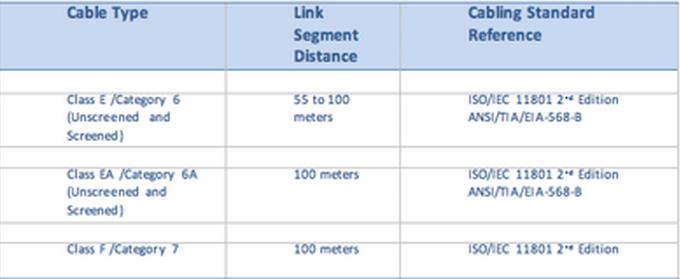
Figure 1 IEEE 802.3an-2006 10GBase-T Cable Standard
The concept of standard, structured cabling provides a long-term underlying foundation of transmission infrastructure that follows a base set of engineering rules. 10GBase-T retains and abides by this by operating over the installed base of twisted-pair copper cabling already in place for lower-speed applications. 10GBase-T uses the same cabling-link-negotiating concepts as do 1GBase-T, 100Base-T and 10Base-T, providing a clear path of bandwidth upgradeability as needed, by leveraging the existing pair infrastructure.
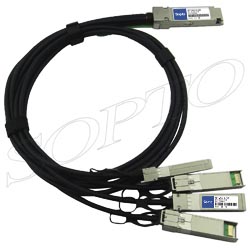
Within a rack, following link segment specifications, the same 10GBase-T copper twisted-pair cabling will enable use with earlier Ethernet generations - 10MB, 100MB and 1GB operation. To extend this further, this same copper twisted-pair cabling is utilized outside the equipment distribution area (EDA) zone, connecting with horizontal distribution area in the data center.
As a technology, 10GBase-T enables network managers to preserve their knowledge base of Ethernet transport while seamlessly upgrading bandwidth capacity from 1G to 10G rates. Additionally, network managers preserve their underlying investment in the maintenance of standard, structured cabling systems.
Limitations arise in the use of SFP+ Direct Attach, as it requires non-standard cabling infrastructure (twin-ax cabling directly attached by each vendor to the SFP+ housing cage) and the confinement to 10GE-only operation. Deviating from standard, structured, cabling contradicts its underlying purpose: to ensure a long-term, infrastructure-orientated, foundation rather than a piece-meal grouping.
As a standard, structured cabling system, twisted pair cables are a known technology to data center cable technicians. Twisted pair cabling offers the ability to field-terminate, as needed, clean lengths in less than a minute. 10GBase-T implementations enable just such a clean, structured cable infrastructure.
SFP+ Direct Attach cables, in contrast, cannot be field-terminated. SFP+ uses a passive twin-ax cable assembly and connects directly into a SFP+ housing; they are specially terminated at the vendor site and must be purchased at pre-determined lengths. This adds overhead to cable management inventory, while preventing a clean, efficient cable infrastructure design.
For more info, please browse our website. For purchasing fiber optic assembly products, please contact a Sopto representative by calling 86-755-36946668, or by sending an email to info@sopto.com.