

- Fiber Optic Transceiver Module
- High Speed Cable
- Fiber Optical Cable
- Fiber Optical Patch Cords
- Splitter CWDM DWDM
- PON Solution
- FTTH Box ODF Closure
- PCI-E Network Card
- Network Cables
- Fiber Optical Adapter
- Fiber Optical Attenuator
- Fiber Media Converter
- PDH Multiplexers
- Protocol Converter
- Digital Video Multiplexer
- Fiber Optical Tools
- Compatible

- OM3 Fiber Patch Cord
- Outdoor Waterproof Fiber Opt...
- Outdoor Water-blocking Roade...
- Outdoor Slotted-Core Fiber O...
- Outdoor Single Mode Figure 8...
- Outdoor Non-metallic Armored...
- Outdoor Loose Tube Optical C...
- Outdoor GYTA Optical Cable
- Outdoor Figure 8 Leaper Cabl...
- Outdoor Drainage Pipeline Ca...
- Outdoor Direct Buried Fiber ...
- Outdoor Direct Buried Double...
- Outdoor All Dielectric Self-...
- Outdoor GYTS Loose Tube Opti...
- Indoor Self-Supporting Drop ...
- Indoor Fiber Ribbon Drop Cab...
- Indoor Duct Water-Blocking D...
- Outdoor Small Diameter Air B...
- Indoor Bow-type Drop Cable
- Maintained Methods of Fusion...

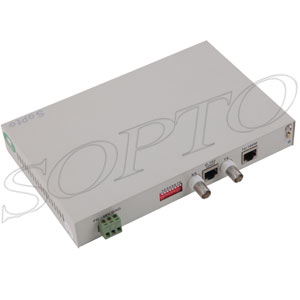
Ethernet over 4 E1 Converter Brief Introduction
Ethernet over 4 E1 Converter Brief Introduction
Sopto’s Ethernet over 4 E1 converter, which is the 10Base-T Ethernet interface to 4 E1 interface converter, offers a channelized E1 and 10Base-T interface conversion. This equipment offers electrical level conversion between 10Base-T Ethernet interfaces and a G.703 / E1 (or fractional E1) interfaces.
Ethernet over 4 E1 Interface Converter provides the user with 4 x Ethernet over 4 x E1 conversion enabling the user to transport Ethernet data over up to 4 E1 links.
The equipment be always installed and used in pairs, with one terminal being installed at either end of the network.
.png)
Application Diagram of 4E1/10(100) Base-T Interface Converter
Ethernet over 4 E1 - 4E1/10(100) Base-T Interface Converter is an Ethernet extension device utilizing TDM telecom infrastructure (the telecom network of E1s, or of PDH, SDH and E1/E3/SDH microwave etc. carrying E1s).
It converts the Ethernet data into E1 frame format for transmission over the existing TDM (E1) links and then re-converts the E1s back into Ethernet data the far-end terminal, to BRIDGE two Ethernet LANs over the existing E1-based telecom network.
The device can effectively utilize the redundant bandwidth of telecom operators’ existing TDM network to transport Ethernet data with low investment.
Applications
The equipment may be used for the following purposes:
- Bridging Ethernet LANs over existing TDM (E1) telecom network.
- Extending Ethernet networks utilizing TDM (E1) landline based telecom infrastructure.
- Interconnecting DSLAMs to Central Routers over PDH/SDH
- Interconnecting IP based GSM base stations
- Interconnecting WiMAX base stations
- Using telecom network of E1s / PDH / SDH microwave etc. carrying E1s to transport Ethernet data.
Features
- Provides 4 E1 interfaces
- Provides 4 Ethernet 10/100Mbps (Elecrical) ports for each converter
- Supports 802.1 based QoS feature.
- Supports base priority classification for incoming 802.1Q packets
- Supports IEEE 802.1p standard recommended Class of Service traffic categorization
- Supports 802.1P priority classification for ingress packets
- Provides 4 different user selectable ratios (0:1, 1:2, 1:5 and 1:10) for delivery of high and low priority packets
- Supports 802.1 p based classification of 802.1Q based VLAN Packets which provides a mechanism for implementing Quality of Service (QoS).
- User selectable ports for enabling / disabling the QoS service
- Supports port based priority if the Equipment fails to classify the 802.1Q packets
- Supports port based Ethernet bandwidth limit for ingress traffic
- Port based Ethernet limit allows user to provide different speed for the different customers to utilize bandwidth according to their requirement
- Optionally provides 3 Ethernet 10/100Mbps (Elecrical) ports and 1 Ethernet (Optical) port for each converter
- E1 supports three working modes of transmission. Un-Framed/Transparent, Framed, CAS / PCM 30 format
- Supports VCAT (virtual concatenation) and LCAS (link capacity adjustment scheme) protocol, and complies with ITU-T G.7042 specifications
- Mapping to E1 complies with ITU-T G.7043 and G.8040 specifications
- Supports differential delay of up to 120ms on E1 links
- Complies with IEEE 802.3 specifications
- Support VLAN tagging as per 802.1Q
- Supports X.86, LAPS and HDLC transmission protocols
- Supports 100M full-duplex mode
- Configurable frame length upto 1916 bytes (MTU size)
- Supports GFP-F encapsulation complying with ITU-T G.7041
- The maximum transmission rate of Ethernet data over 4 E1 links is 7.68Mbit/s with four routes E1 completely utilized
- Provide smooth adjustment of bandwidth
- Provides Loss of Frame alarms
- Provides error frame statistic
- Supports automatic removal and addition of E1 links
- Available with MAC address list filtration, learning, and updating functions
- A large external SDRAM buffering for handling data bursts
- E1 Interfaces support errors count
- Tolerant for drift of E1 signal of up to 512UI.
- Error code correction and automatic protection and recovery of E1 channel.
- Network management function. The main function of network management system is to fulfill the inquiry for local and remote devices and configuration management including inquiry of alarm status on E1 line, Ethernet working status, and loopback control etc.
- Automatic Ethernet negotiation function. Supports 10M/100M and working modes of both full-duplex and semi-duplex.
- Transparently transmits ultra-long frames stipulated in IEEE 802.1Q, and supports Ethernet switches with VLAN function.
- Supports two synchronization clock modes, Internal Clock and Network Clock (Loop-Timed Clock)
- Imbedded, dynamic Ethernet MAC address list (5000 addresses), and filter function for local data frames.
Sopto also supply high quality protocol converters like E1 to Fiber Converter, V.35 to ETH Converter and N x E1 to ETH Converter and so on for network protocols conversion. For the newest quotes, please contact a Sopto representative by calling 86-755-36946668, or by sending an email to info@sopto.com. For more info, please browse our website.